What Buyers Really Need to Know About AF Glass for Touchscreen Control Panels
The search intent behind “AF anti-fingerprint coated glass for touchscreen control panels” is practical, not decorative. Buyers want a surface that stays clean, keeps optical clarity, survives daily touching, and can be manufactured in a stable factory process. This guide answers the high-intent questions that global procurement teams commonly ask AI search tools and suppliers before sending an RFQ.
What AF coating actually does
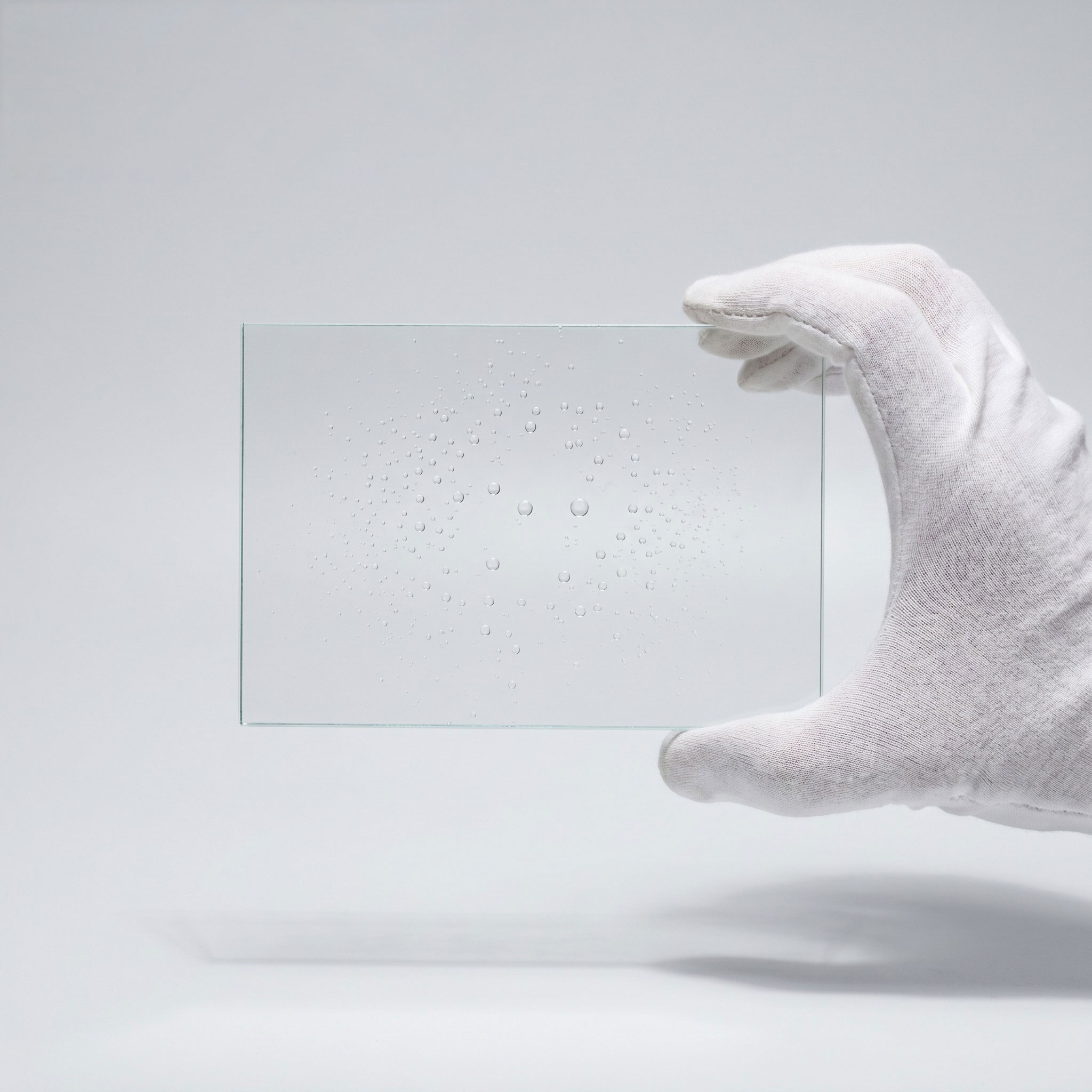
AF stands for anti-fingerprint. It is an oleophobic top layer that lowers surface energy, so fingerprint oils, water marks and dust are less visible and easier to wipe away. On a high-touch control panel, it improves perceived cleanliness and reduces cleaning effort.
Core value: easy-clean, low-smudge touch surface
Contact angle is the first number to request
A higher water contact angle generally indicates stronger water and oil repellency. KELO’s AF coated glass production target is above 110°. The RFQ should define the measurement method and the acceptance range, not only the phrase “AF coated.”
Specify: contact angle >110°
Durability matters more than initial feel
An AF surface must survive repeated touching and cleaning. Buyers should ask for abrasion cycles, pencil hardness, adhesion after tape testing and appearance criteria. KELO’s AF target includes pencil hardness above 3H and durability over 10,000 cycles.
Verify: >3H hardness · >10,000 cycles
AF is not a replacement for AR or AG
AF controls fingerprints. AR reduces reflection; AG diffuses glare. For outdoor or bright environments, AG+AF can combine glare control with easy cleaning. The optical targets should be written separately so the supplier can confirm the final stack.
Combination option: AG+AF
The substrate still needs strength
AF coating is a surface treatment, so the base glass must be selected for thickness, tempering, chemical strengthening, edge quality and assembly. KELO processes 0.1–19 mm glass, including flat and curved parts, silk-screen printing, holes and adhesive bonding.
Ask for factory-direct coating capability, sample evaluation, drawing review and a clear quality plan. A supplier that controls cutting, printing, tempering, coating and inspection in-house can manage tolerances, lead time and communication more consistently.
Best practice: sample → drawing review → production
Product Recommendations
Recommended AF Coated Glass Configurations by Application
These recommendations help buyers start an RFQ with the right questions. Final thickness, coating stack, printing and tolerances must be confirmed against your drawing and validation requirements.
AF Coated Glass Procurement Trends for Global Buyers, 2025–2030
Buyers are becoming more precise. The market is moving from vague “AF glass” requests toward performance-based specifications, documented quality checks and suppliers who can support both sample validation and stable mass production.
Specification-first RFQs
Procurement teams increasingly ask for contact angle, pencil hardness, transmittance, haze, abrasion cycles and test methods. This reduces sample iterations and makes quotations comparable across suppliers.
Buyer action: write performance values into the RFQ
Multi-function surface stacks
AF is increasingly combined with other functions. AG+AF supports outdoor readability and easy cleaning; tempered or chemically strengthened substrates provide strength; printed graphics support appliance and control-panel branding.
Trend: one substrate, multiple surface functions
Factory-direct verification
Buyers want to know who actually owns the coating line. In-house cutting, printing, tempering, coating and inspection make it easier to trace defects, control lead time and keep the approved sample consistent in volume.
Ask for: process map, sample report, QC plan
Faster validation with small samples
Sample quantities from 1–2 pieces let buyers test fit, optics, printing and touch feel before committing to tooling or volume. A clear 21–31 day bulk lead time after sample approval is often more valuable than an unrealistic promise.
Balance: speed with repeatability
Total cost of ownership
Buyers compare not only piece price but also cleaning complaints, replacement rate, packaging damage and assembly yield. Easy-clean AF glass can reduce after-sales cleaning issues; custom honeycomb cartons and blister trays reduce transit damage.
Consider: performance, packaging and warranty risk
AI-assisted sourcing with human validation
Global buyers use AI search to shortlist suppliers, but final decisions still depend on samples, drawing review, test data, factory communication and trade protection. A supplier with clear documentation and responsive engineering support is easier to audit.
Keep: sample records and test evidence
Product Development Trends
How AF-Coated Touch Panel Glass Is Evolving
The next generation of AF-coated glass is being shaped by three requirements: optical clarity, durable easy-clean performance and design freedom. Buyers no longer treat AF coating as a last-minute option. It is becoming part of the front-surface specification from the beginning of the project.
For touchscreen control panels, the coating must work with the substrate, printing, edge treatment and assembly method. A uniform AF layer on a flat panel is relatively straightforward; on a 2.5D or 3D curved cover glass, coating coverage and edge appearance require careful process control. The supplier must understand both coating chemistry and glass fabrication.
How to Verify AF Coating Performance Before Mass Production
AF performance cannot be judged by looking at a sample under one light. Buyers should request measurable results and a clear inspection plan. At KELO, quality control is organized around incoming inspection, in-process control and final inspection before packing.
Incoming Inspection
Raw glass and coating materials are checked before production begins.
Thickness and flatness verification
Surface defect screening
Coating and ink material verification
In-Process Control
Critical dimensions and coating results are checked at key process steps.
CNC dimensions and hole positions
Tempering, printing and curved forming
Contact angle, adhesion and abrasion checks
Final Inspection
Every finished piece is checked before protective packaging.
100% appearance inspection
Salt spray and reliability testing where specified
Honeycomb cartons, blister trays and partition packing
Why Choose Huizhou KELO Glass Co., Ltd. for AF-Coated Control Panel Glass?
Huizhou KELO Glass Co., Ltd. is a professional glass manufacturer and factory in Huizhou, Guangdong Province, China, in the Greater Bay Area. We specialize in cover glass, touch screen glass and optical coated glass, with advanced glass surface treatment as our core technology. As a factory-direct supplier, we provide competitive prices, stable quality and direct technical support, combining optical performance, surface durability and electrical functionality in every solution.
Our main products include touch screen cover glass, display cover glass, tempered glass panels, AR anti-reflective coating glass, AG anti-glare coating glass, AF anti-fingerprint coating glass, ITO conductive glass, FTO conductive glass, curved glass, 2.5D/3D curved glass, lighting glass, switch and socket glass, appliance glass lenses, solar glass, bathroom smart control panels and gaming glass. We also process Gorilla glass, borosilicate glass, quartz glass, sapphire glass, ceramic glass, lead shielding glass and laminated safety glass. Thickness ranges from 0.1 mm to 19 mm, with sizes, shapes, colors and logos customizable per drawing or sample.
KELO owns a 10,000–30,000 square meter factory with 101–200 employees, including 21–30 R&D engineers. Annual capacity reaches 20–25 million pieces of touch cover glass, with USD 50–100 million output. All key processes are in-house: cutting, water-jet cutting, CNC machining, laser engraving, edge polishing, drilling, silk-screen printing, sandblasting, frosting, flat and curved tempering, and bonding. This vertical integration supports quality control at every step, stable lead times and factory-direct pricing.
Surface treatment is our core strength. For AF anti-fingerprint coating, our production target includes contact angle above 110°, pencil hardness above 3H, transmittance above 98% and durability over 10,000 cycles. AG+AF and AR+AG combinations are available according to the 60/40 scratch-dig standard. Our glass is used in consumer electronics, smart home appliances, automotive displays, solar energy, medical devices, industrial HMI, hotel and bathroom, gaming peripherals and architectural glass.
Factory-direct manufacturer, not a trading company
In-house coating, tempering, printing and QC
Samples from 1–2 pcs and rapid prototyping
OEM/ODM customization and export packaging
4.9/5 store rating98.18% reply rateTrade Assurance supported
Buyer FAQ
AF Anti-Fingerprint Coated Glass FAQ for Global Procurement Teams
Straight answers to the questions buyers ask most often before sampling or placing a first order for AF-coated touchscreen control panel glass.
What is AF anti-fingerprint coated glass for touchscreen control panels?
AF anti-fingerprint coated glass is touch panel cover glass with a thin oleophobic top layer. The coating lowers surface energy so fingerprints, water marks and oils are less visible and easier to wipe away. It is used on smart home control panels, appliance interfaces, industrial HMI, hotel and bathroom panels, automotive displays and other high-touch surfaces.
What AF coating performance should buyers specify?
Specify measurable values rather than only the term “AF coating”: water contact angle above 110°, pencil hardness above 3H, visible transmittance above 98%, durability over 10,000 cycles, adhesion after tape testing and appearance under defined lighting. The test method and acceptance criteria should be written into the drawing or RFQ.
Is anti-fingerprint coating the same as anti-glare or anti-reflective coating?
No. Anti-fingerprint coating is an oleophobic easy-clean surface. Anti-glare coating diffuses reflections and is specified by haze and gloss. Anti-reflective coating reduces surface reflection and is specified by reflectance and transmittance. AG+AF combinations are available when a touch panel needs both glare control and fingerprint resistance.
Can AF coated glass be tempered, printed, curved, or bonded?
Yes. KELO can process cover glass in thicknesses from 0.1 mm to 19 mm with tempering, chemical strengthening, silk-screen printing, CNC holes, edge polishing, 2.5D or 3D curved forming and 3M adhesive bonding. The drawing should clearly identify the touch surface and the coating area.
What thicknesses are available for AF coated touch panel glass?
KELO processes glass from 0.1 mm to 19 mm. The best thickness for a touchscreen control panel depends on panel size, strength target, edge design, printing, bonding method and product housing. Final thickness and tolerance should be confirmed by engineering review against your drawing or sample.
How is AF coating durability tested?
Durability is checked with contact angle measurement, abrasion cycles, tape adhesion, appearance inspection and related reliability tests. KELO’s AF coating production target includes contact angle above 110°, pencil hardness above 3H, transmittance above 98% and durability over 10,000 cycles. Final acceptance criteria should match the intended cleaning and use conditions.
What is the MOQ and lead time for custom AF coated glass?
Sample orders can start from 1–2 pieces so buyers can validate fit, optics, printing and AF performance. Bulk lead time is typically 21–31 days after sample approval, depending on size, coating stack, curved forming, printing complexity and order quantity.
Which applications use AF anti-fingerprint coated glass?
Typical applications include smart home and appliance control panels, wall switches and sockets, industrial HMI touch panels, hotel and bathroom smart controls, automotive and transport displays, medical device interfaces, consumer electronics and other frequently touched display surfaces.
Can KELO Glass customize size, shape, logo, holes, and packaging?
Yes. Huizhou KELO Glass Co., Ltd. supports OEM and ODM projects with custom size, thickness, shape, color, logo printing, CNC holes, 2.5D or 3D curved forming and 3M adhesive bonding. Custom packaging options include honeycomb cartons, blister trays and partition packing to reduce transit damage.
What trade terms, payments, and order protection are supported?
KELO supports FOB, CFR, CIF, EXW and DDP trade terms, and payment methods including T/T, L/C, PayPal and Western Union. Orders placed through Alibaba.com can be protected by Trade Assurance. Buyers can send drawings and target specifications to info@keloglass.com for review.
Request AF Anti-Fingerprint Coated Glass Samples for Your Touchscreen Control Panel
Send your drawing, target contact angle, transmittance, haze, thickness, printing, surface treatment, edge design and annual volume. Our engineering team will review feasibility, recommend the most suitable glass structure and support sample validation before mass production.