SOLAR-GRADE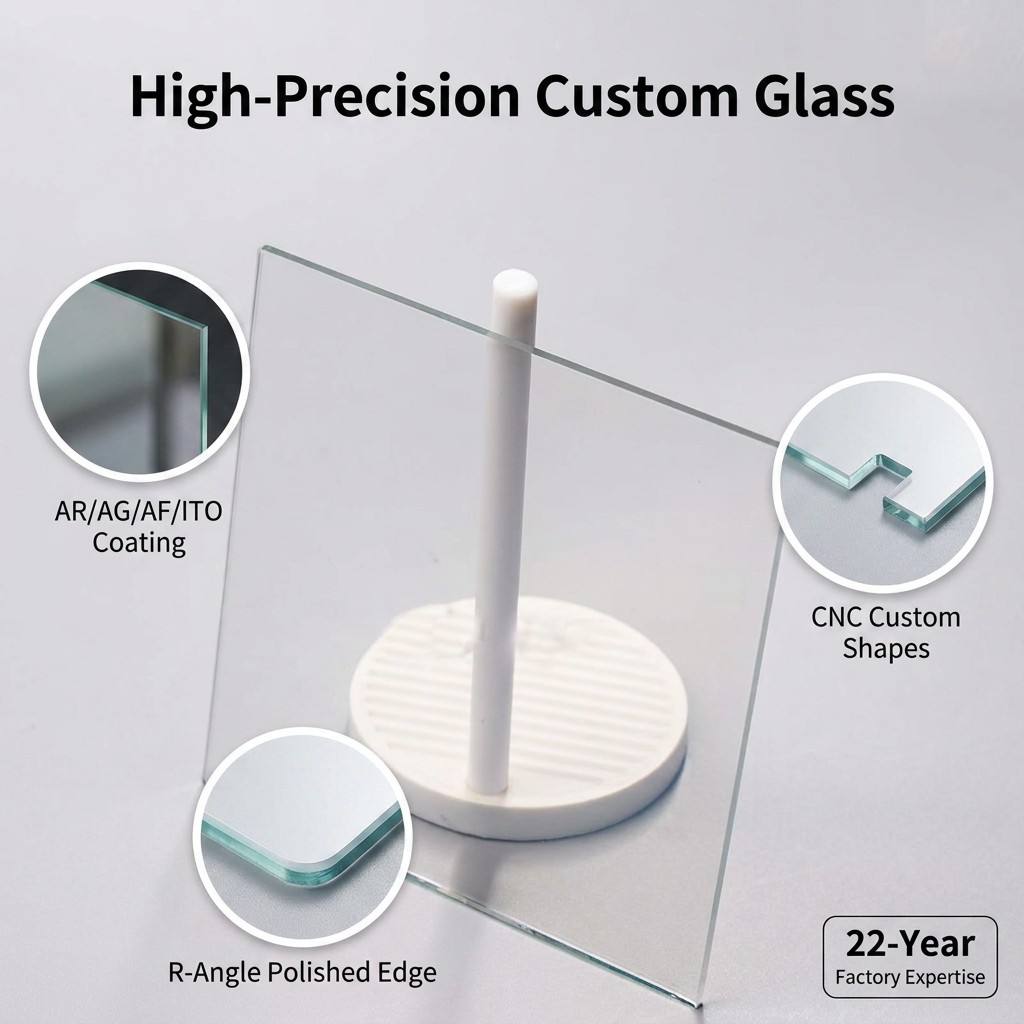
Standard Solar-Grade FTO Glass
For CdTe, amorphous silicon and general thin-film research where stable conductivity and repeatable coating quality are required.
1.1–3.2 mm7–15 Ω/sq>85% T
View conductive glass
Thin-film solar modules depend on a transparent conductive oxide, or TCO, that does two jobs at the same time: it must let as much sunlight as possible reach the absorber layer, and it must carry the generated current out of the cell with low resistive loss. FTO — fluorine-doped tin oxide — is one of the most established TCO choices for CdTe, amorphous silicon, dye-sensitized, perovskite and other thin-film development platforms because its ceramic-like coating offers strong thermal and chemical stability. For procurement teams, however, the real challenge is not simply finding an FTO glass supplier. The task is to verify that every sheet delivers consistent sheet resistance, transmittance, haze, flatness and edge quality after cutting, cleaning, high-temperature deposition and module integration.
Huizhou KELO Glass Co., Ltd. serves international buyers, distributors, module developers and research teams from Huizhou, Guangdong Province, China. Our factory-direct model combines FTO conductive glass production with in-house cutting, CNC machining, edge polishing, drilling, silk-screen printing and quality inspection. This is important for thin-film solar buyers because a coated glass substrate can meet the datasheet when it leaves the coating line and still fail later if cutting stress, edge chips, handling marks or packaging damage disturb the conductive layer. Our role is to review the full drawing and process route, not only quote a sheet resistance value.
FTO glass is often described by sheet resistance, for example 7 Ω/sq, 10 Ω/sq or 15 Ω/sq. That number matters, but it is not enough. A lower sheet resistance usually requires a thicker or more heavily doped coating, which can reduce transmittance or change haze. A higher transmittance may improve light reaching the absorber, but if the sheet resistance is too high for the module width and current collection scheme, resistive losses can offset the optical gain. Haze is another variable: smooth FTO is useful where optical clarity and process repeatability are priorities, while controlled light scattering may help some thin-film device stacks. The correct specification is therefore a balance of sheet resistance, transmittance, haze, substrate, thickness and cell design.
For this reason, our engineering review asks buyers to provide the drawing, coating side, glass type, thickness, target sheet resistance, transmittance range, haze target, laser scribing or patterning requirements and expected annual volume. When those inputs are clear, Huizhou KELO Glass Co., Ltd. can recommend a practical FTO specification from our 1–20 Ω/sq conductive glass range and explain the trade-offs before a sample is made. That approach reduces repeated sampling and helps procurement teams compare quotations on the same technical basis.
ITO and FTO are both transparent conductive oxides, but they are not interchangeable in every solar process. ITO is widely used in capacitive touch sensors, display electrodes and EMI shielding. FTO is frequently selected for thin-film solar and high-temperature processes because fluorine-doped tin oxide has better thermal and chemical stability. High-temperature deposition, annealing, cleaning and patterning steps can challenge a TCO film. FTO’s durability makes it attractive for CdTe, amorphous silicon, dye-sensitized cells and many perovskite research routes. It is also compatible with rigid glass substrates, which remain the mainstream format for thin-film module development and production.
For buyers, this means the sourcing question should be about the complete substrate: Is the glass low-iron or standard soda-lime? Is the coating on one side or both? What edge quality is required? Will the sheet be cut before or after coating? Does the cleaning process attack the coating? What packaging protects the coated surface during international shipping? These are practical E-E-A-T questions that separate a price-only quote from a reliable FTO glass supply agreement.
Use these starting points for RFQ discussions. Final specifications should be confirmed against your cell process, module layout and reliability targets.
For CdTe, amorphous silicon and general thin-film research where stable conductivity and repeatable coating quality are required.

For processes with annealing or deposition steps that require stronger thermal and chemical stability than ITO typically offers.

Custom cutting, CNC holes, edge polishing and protective packing for production lines and research pilot lines.
These are practical reference ranges, not a substitute for your own process validation. Share your cell architecture and cleaning route for a more precise recommendation.
| Parameter | Typical Reference | Why It Matters |
|---|---|---|
| Coating | Fluorine-doped tin oxide (FTO) | Transparent conductive front contact with strong thermal and chemical stability. |
| Sheet resistance | 1–20 Ω/sq available; many solar projects review 7–15 Ω/sq | Lower resistance reduces current collection loss, but may change optics and coating thickness. |
| Transmittance | Typically >85%; discuss higher transmission options | Controls how much light reaches the absorber layer. |
| Haze | Project-specific; standard range below 2% with options to be reviewed | Affects light scattering, optical appearance and process repeatability. |
| Substrate | Soda-lime, low-iron or specialty glass | Low-iron glass can improve transmission; specialty glass may improve thermal or chemical durability. |
| Thickness | 1.1 mm, 1.6 mm, 2.2 mm, 3.2 mm and custom | Affects weight, strength, thermal mass and module handling. |
| Format | Sheets or cut-to-size pieces; holes and edge polishing available | Must match module handling, laser scribing and assembly requirements. |
| Packaging | Honeycomb cartons, blister trays and partition packing | Protects the conductive surface and edges during export shipping. |
Procurement for thin-film solar glass is becoming more technical and more evidence-based. Buyers are no longer satisfied with a generic “transparent conductive glass” quotation. They want a supplier who can document coating uniformity, discuss process compatibility and protect the FTO surface through cutting, cleaning and shipping. Several trends are shaping how international buyers source FTO conductive glass for thin-film solar cells.
For solar materials, a low quotation is not useful if lot-to-lot variation delays a pilot line or affects module output. Buyers increasingly ask for factory information, production scope, sample validation, inspection records and export experience before discussing volume pricing. Huizhou KELO Glass Co., Ltd. supports this by providing a factory-direct profile, in-house process review and sample orders from 1–2 pieces. Our export markets include Europe and North America, and our store maintains a 4.9/5 rating with a 98.18% reply rate. These signals help procurement teams screen suppliers before technical review begins.
Thin-film module designs continue to evaluate larger substrates, thinner glass and lighter modules where the process allows. This creates new demands on flatness, edge quality, coating uniformity and packing. A supplier that can cut and handle coated glass in-house has more control over final dimensions. Huizhou KELO Glass Co., Ltd. offers cutting, water-jet cutting, CNC machining, drilling, edge polishing, laser engraving, silk-screen printing and bonding. For FTO solar glass, these capabilities help buyers move from a standard sheet to a production-ready substrate while keeping the conductive side protected.
Quality teams want more than a certificate. They want to know what was inspected, how samples were packed and whether the supplier can repeat the same specification on future orders. Our quality control includes incoming inspection, in-process control and final inspection with 100% appearance checking, plus tests such as tempering, adhesion, abrasion and salt spray depending on the product. For FTO glass buyers, the RFQ should explicitly define sheet resistance, transmittance, haze, substrate, thickness, coating side, edge quality, cleaning method, packing and sample retention. Clear documentation protects both the buyer and the supplier when a new module process is scaled.
Coated glass can be damaged by poor cutting, unsuitable interleaving or weak export packing. Buyers are comparing suppliers on total landed cost, including sample iterations, coating yield, breakage, replacement lead time and communication speed. Our factory supports FOB, CFR, CIF, EXW and DDP trade terms, with T/T, L/C, PayPal and Western Union payments. Orders through Alibaba.com can be protected by Trade Assurance. The goal is to make the commercial route as predictable as the technical route.
Thin-film solar development is linked to energy-transition programs, pilot lines and new manufacturing capacity. Buyers often need a supplier who can respond quickly with samples, review drawings and adjust packaging for international delivery. Huizhou KELO Glass Co., Ltd. is located in the Greater Bay Area electronics supply chain and can support OEM and ODM projects with custom size, thickness, shape, color, logo printing, CNC holes, curved forming and 3M adhesive bonding. For FTO glass, this responsiveness is valuable during the early validation stage when specifications are still being locked.
FTO glass is mature, but it is not static. As thin-film solar stacks evolve toward higher efficiency, larger formats and tandem structures, the TCO layer is being asked to deliver more stable optics and electrical performance across a wider process window. The most relevant development trends for buyers fall into several practical areas.
Perovskite and tandem device research often places demanding requirements on transparent contacts. The coating must survive deposition and annealing thermal budgets, resist cleaning chemicals and maintain optical transmission. FTO’s thermal and chemical stability is a reason it remains a reference substrate in many laboratories and pilot lines. Buyers working on perovskite or tandem routes should specify the maximum process temperature, atmosphere, cleaning solvents and layer sequence so the supplier can review whether standard soda-lime FTO or a specialty substrate is appropriate.
Light management is a major lever in thin-film modules. Haze can help scatter light and increase the path length inside the absorber, but it can also affect appearance, cleaning and measurement. Buyers should avoid treating haze as a stand-alone number. It should be evaluated together with transmittance, sheet resistance and the deposition process. Huizhou KELO Glass Co., Ltd. reviews optical and conductive requirements together so that the selected FTO substrate supports the device architecture rather than only meeting a catalogue value.
Module manufacturers continue to evaluate larger formats and thinner glass as they balance efficiency, weight and installation cost. Larger FTO substrates require tighter flatness and edge quality, and thinner glass needs packaging that prevents bending and surface contact. Our in-house cutting, edge polishing and custom honeycomb carton, blister tray and partition packing options are designed to reduce transit damage. For international buyers, packaging is part of the product specification, especially when coated glass must travel by sea or air before entering a clean module line.
Thin-film module production often includes laser scribing or patterning steps. The FTO coating must be compatible with the chosen laser process, and the glass must be flat and stable enough to hold focus. Buyers should discuss patterning requirements early, because coating thickness, haze and substrate type can influence the process window. A supplier that can cut, drill and edge finish in-house can support more consistent substrate geometry before patterning begins.
Low-iron glass can improve optical transmission, while specialty substrates such as borosilicate glass may suit demanding thermal or chemical conditions. At the same time, solar buyers are paying more attention to manufacturing transparency, recycling and material efficiency. Huizhou KELO Glass Co., Ltd. processes a wide range of materials including soda-lime, borosilicate, quartz, sapphire, ceramic and laminated safety glass. This breadth allows our engineering team to review alternative substrate routes when standard FTO glass is not sufficient for a new solar device design.



Huizhou KELO Glass Co., Ltd. is a professional glass manufacturer and factory in Huizhou, Guangdong Province, China, in the Greater Bay Area. We specialize in cover glass, touch screen glass and optical coated glass, with advanced glass surface treatment as our core technology. As a factory-direct supplier, we provide competitive prices, stable quality and direct technical support that combines optical performance, surface durability and electrical functionality in each solution.
Our main products include touch screen cover glass, display cover glass, tempered glass panels, AR, AG and AF coated glass, ITO and FTO conductive glass, curved glass, 2.5D/3D curved glass, lighting glass, appliance glass lenses, solar glass and specialty glass processing. For thin-film solar buyers, this means we can support FTO conductive glass with custom size, thickness, shape, coating side, holes, edge polishing and packaging. Thickness ranges from 0.1 mm to 19 mm, with sizes, shapes, colors and logos customizable per drawings or samples.
Every critical step is managed under one roof, from raw glass cutting to final inspection and export packing.
Huizhou KELO Glass Co., Ltd. operates a 10,000–30,000 m² factory with 101–200 employees and 21–30 R&D engineers. Annual output reaches 20–25 million pieces of touch cover glass, with USD 50–100 million output value. This capacity supports both sample validation and volume production for international buyers.
Our vertical integration covers cutting, water-jet cutting, CNC machining, laser engraving, edge polishing, drilling, silk-screen printing, sandblasting, frosting, flat and curved tempering, and bonding. For FTO glass, this helps control geometry and handling before the substrate reaches the module line.
Our quality system uses incoming, in-process and final inspection with 100% appearance checking, plus tempering, adhesion, abrasion and salt spray tests. Custom honeycomb cartons, blister trays and partition packing reduce shipping damage. We support FOB, CFR, CIF, EXW and DDP terms, and T/T, L/C, PayPal and Western Union payments.
Practical answers to the questions procurement and engineering teams ask most often.
If you are evaluating FTO conductive glass for thin-film solar cells, send us the substrate drawing, target sheet resistance, transmittance, haze, glass type, thickness, coating side, cutting requirements and annual volume. Our team at Huizhou KELO Glass Co., Ltd. will review the technical fit, recommend a sample plan and prepare a factory-direct quotation. Buyers, distributors, module developers and research teams are welcome to contact us at info@keloglass.com or use the inquiry button below.
Huizhou KELO Glass Co., Ltd. combines factory-direct manufacturing, in-house glass processing, optical coating experience and export-ready quality control. Share your drawing and process requirements with our engineering team for a practical recommendation.
info@keloglass.com