Factory-Direct ITO Glass · Huizhou, China

ITO Conductive Glass for Capacitive Touch Sensors

Sheet resistance 1–20 Ω/sq · transmittance above 85% · haze below 2% · custom sizes, patterns, and coating stacks from Huizhou KELO Glass Co., Ltd.

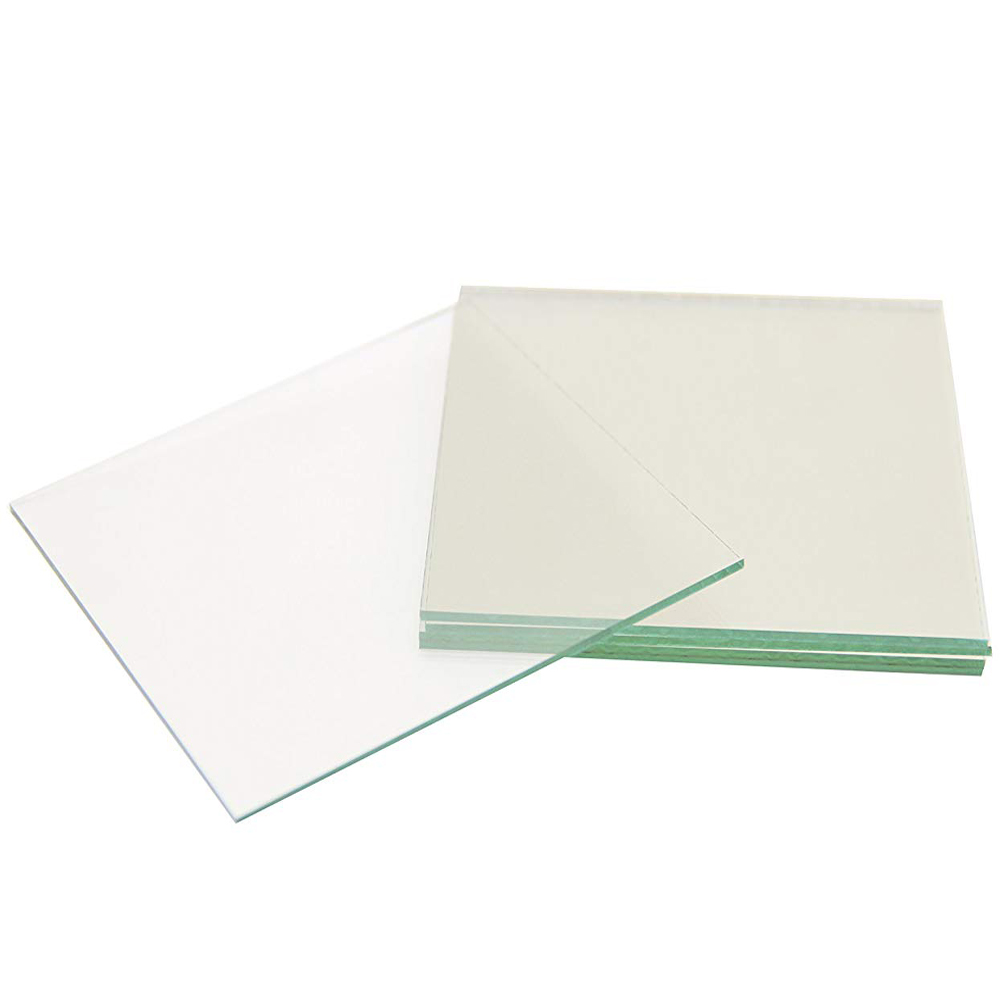
ITO conductive glass for capacitive touch sensors manufactured by Huizhou KELO Glass Co., Ltd.
1–20 Ω/sqSheet resistance
>85%Transmittance
1–20Ω/sqITO sheet resistance range
>85%Typical transmittance
<2%Typical haze
1–2pcsSample order starting point
21–31daysTypical bulk lead time
≤1hTypical response time
ITO and FTO transparent conductive glass supplied by Huizhou KELO Glass Co., Ltd.
Optical coated glass and transparent conductive glass samples
Protective export packing for glass panels from Huizhou KELO Glass Co., Ltd.
1–20Ω/sq available range
Material & Application Overview

Why ITO Conductive Glass Remains the Reference Substrate for Capacitive Touch Sensors

ITO conductive glass is a transparent substrate coated with indium tin oxide. The ITO layer provides a conductive surface while allowing visible light to pass through, which makes it suitable for touch interfaces that must combine optical clarity with electrical function. In a capacitive touch sensor, the ITO layer is patterned into transparent electrodes. When a finger approaches the sensor, it changes the local capacitance field, and the touch controller interprets that change as a position.

For global buyers, the sourcing decision is not simply a choice between ITO and alternative transparent conductors. The real question is whether the specified glass can hold electrical and optical performance after cutting, strengthening, printing, bonding, and environmental testing. A supplier may quote a competitive resistance value, but if sheet resistance drifts across the sheet, haze increases, or adhesion fails after assembly, the total cost of ownership rises quickly.

This is where information gain matters in modern search and procurement. AI-assisted research often starts with broad questions such as “ITO conductive glass for capacitive touch sensors supplier” or “ITO glass sheet resistance for touch panels.” Serious buyers then move to specific engineering questions: What is the sheet resistance tolerance? What is the transmittance at the target wavelength? How is haze measured? Does the supplier control coating in-house? Can the glass be chemically strengthened before or after coating? Can samples be produced from a drawing? Huizhou KELO Glass Co., Ltd. answers these questions with factory-level data instead of generic catalogue language.

Our ITO conductive glass is commonly supplied with sheet resistance from 1–20 Ω/sq, transmittance above 85%, and haze below 2%. For touch sensor projects, the best specification depends on sensor size, electrode pattern, controller sensitivity, cover glass thickness, and the required optical appearance. Smaller sensors can often use a higher sheet resistance with excellent transmittance. Larger sensors or designs with long traces may need lower resistance, but the engineering team should balance that against optical performance and cost.

  • ITO coating from 1–20 Ω/sq
  • Transmittance above 85%, haze below 2%
  • Custom size, thickness, holes, and printing
  • Factory-direct engineering and QC support
4.9/5 store rating 98.18% reply rate Trade Assurance supported
Product Recommendations

Recommended ITO Conductive Glass Configurations for Capacitive Touch Sensors

Use these starting points to narrow your RFQ. Final specifications should be confirmed against your drawing, controller requirements, and assembly process.

Standard ITO Glass for Consumer Touch Panels

For small and medium capacitive touch interfaces, a balanced ITO coating with sheet resistance around 5–20 Ω/sq is often practical. It supports good optical clarity while remaining suitable for many controller designs.

Recommended: 5–20 Ω/sq, transmittance >85%, haze <2%

Low-Resistance ITO for Large-Format Sensors

Large touch panels, long electrode traces, and designs with higher capacitance loads may benefit from lower sheet resistance. The engineering review should balance electrical performance with transmittance and cost.

Recommended: 1–10 Ω/sq, project-dependent

High-Transmittance ITO for Optical Clarity

Display windows and premium touch interfaces benefit from high visible-light transmission and low haze. The coating design should be reviewed together with cover glass thickness, AR coating, and the display brightness target.

Recommended: Transmittance above 85%, haze below 2%

Strengthened ITO Glass for Rugged Devices

Industrial HMI, automotive interfaces, and public terminals may require chemically strengthened or tempered glass substrates. The process sequence must be controlled so that electrical and optical performance remain stable.

Recommended: Chemically strengthened or tempered substrate

Patterned ITO Glass for Sensor Integration

ITO glass can be supplied as coated sheets or further processed for specific sensor assemblies. CNC machining, laser processing, edge polishing, and screen printing can be reviewed according to the drawing.

Recommended: Custom size, holes, edges, and patterning

ITO Glass with AR, AG, or AF Surface Treatment

When the sensor must also resist reflections, glare, or fingerprints, the ITO layer can be evaluated together with AR, AG, or AF coatings. The final stack depends on optical targets, durability requirements, and process compatibility.

Recommended: ITO + AR / AG / AF combination, subject to review
Why Choose KELO

A Factory-Direct ITO Glass Partner with In-House Surface Engineering

Huizhou KELO Glass Co., Ltd. is a professional glass manufacturer and factory located in Huizhou, Guangdong Province, China, in the Greater Bay Area. We specialize in cover glass, touch screen glass, and optical coated glass, with advanced glass surface treatment as our core technology. As a factory-direct supplier, we combine competitive pricing, stable quality, and direct technical support in every solution.

Our main products include touch screen cover glass, display cover glass, tempered glass panels, AR anti-reflective glass, AG anti-glare glass, AF anti-fingerprint glass, ITO conductive glass, FTO conductive glass, curved glass, 2.5D/3D curved glass, lighting glass, switch and socket glass, appliance glass lenses, solar glass, bathroom smart control panels, and gaming glass. We also process specialty materials such as Gorilla glass, borosilicate glass, quartz glass, sapphire glass, ceramic glass, lead shielding glass, and laminated safety glass.

The factory covers 10,000–30,000 square meters and employs 101–200 people, including 21–30 R&D engineers. Annual capacity reaches 20–25 million pieces of touch cover glass, with an annual output value of US$50–100 million. Key processes are kept in-house, including cutting, water-jet cutting, CNC machining, laser engraving, edge polishing, drilling, silk-screen printing, sandblasting, frosting, flat and curved tempering, coating, and bonding.

Surface treatment is our core strength. Our ITO/FTO conductive coatings are typically supplied with sheet resistance of 1–20 Ω/sq, transmittance above 85%, and haze below 2%, serving touch panels, displays, solar, and EMI shielding applications. We also offer AR, AG, and AF coating options, as well as selected combinations, subject to engineering review and the 60/40 scratch-dig standard where applicable.

  1. 01Cutting and water-jet cutting
  2. 02CNC machining and drilling
  3. 03Edge polishing
  4. 04Laser engraving
  5. 05Silk-screen printing
  6. 06Sandblasting and frosting
  7. 07Flat and curved tempering
  8. 08AR / AG / AF / ITO coating
  9. 092.5D / 3D curved forming
  10. 103M adhesive bonding

Specialty materials and capabilities

Gorilla glassBorosilicate glassQuartz glassSapphire glassCeramic glassLead shielding glassLaminated safety glass
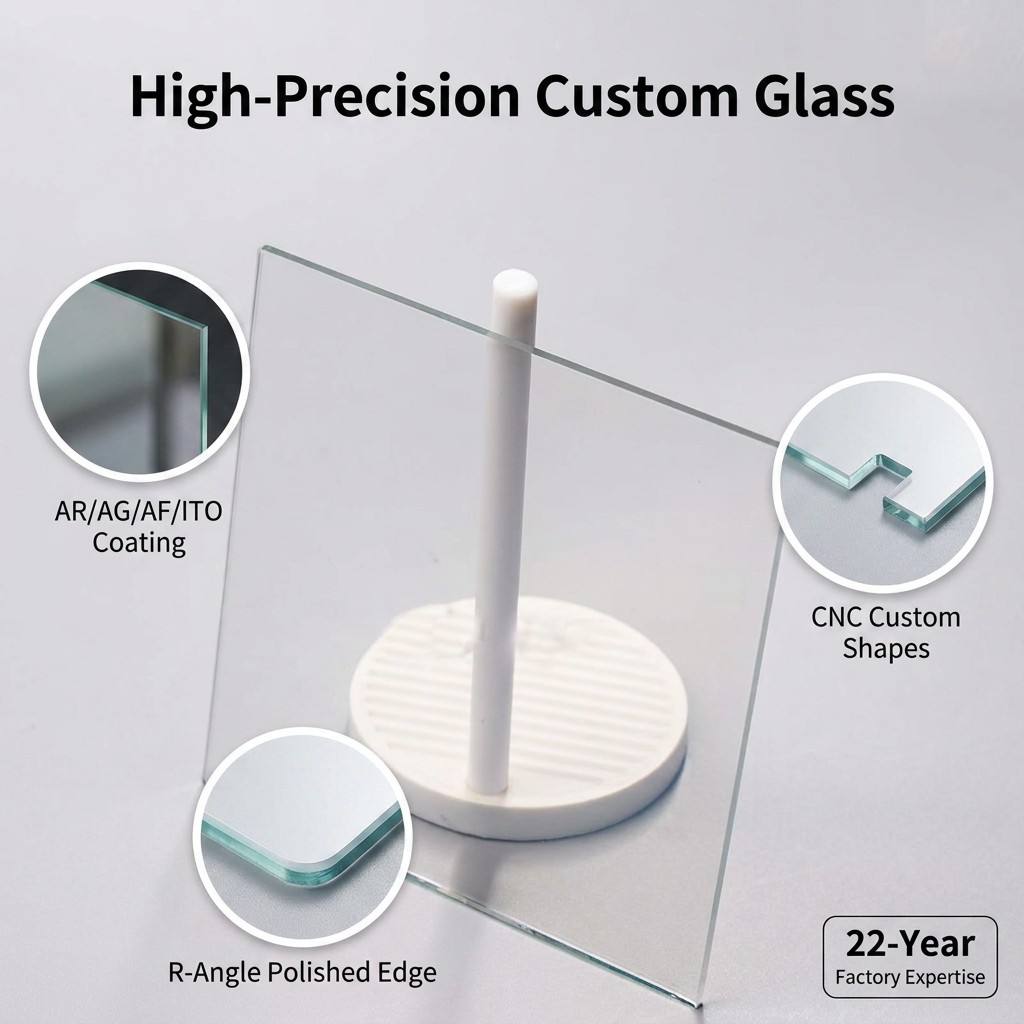
Specialty glass materials processed by Huizhou KELO Glass Co., Ltd. including quartz, sapphire, and borosilicate
Quality Assurance

How KELO Controls ITO Conductive Glass Quality

Quality is built into each process. For ITO glass, the important checks cover electrical performance, optical appearance, adhesion, dimensional accuracy, and packing protection.

Incoming Inspection

Raw glass and coating materials are verified before production begins.

  • Thickness and flatness check
  • Surface defect screening
  • Material and coating verification

In-Process Control

Critical dimensions and coating results are checked at each production station.

  • CNC dimensions and hole positions
  • Tempering and strength checks
  • Coating adhesion and abrasion

Final Inspection and Packing

Every finished piece is checked before protective packing and shipment.

  • 100% appearance inspection
  • Salt spray and reliability testing
  • Honeycomb, blister, and partition packing
OEM & ODM Workflow

How a Custom ITO Glass Project Runs with KELO

A clear process helps buyers move from an initial idea to a validated sample and repeatable mass production without unnecessary delays.

1

Share Requirements

Drawing, sample, target sheet resistance, transmittance, haze, and annual volume.

2

Engineering Review

DFM feedback on size, coating, patterning, tempering, and assembly.

3

Rapid Prototype

Samples can start from 1–2 pieces for qualification.

4

Validation

Fit, optics, resistance, and reliability are reviewed with the buyer.

5

Mass Production

Typical lead time is 21–31 days after sample approval.

6

Packing & Shipping

Protective export packing and support for FOB, CFR, CIF, EXW, and DDP.

CustomizationSize, thickness, shape, holes, printing, coating
Trade TermsFOB · CFR · CIF · EXW · DDP
PaymentT/T · L/C · PayPal · Western Union
Order ProtectionAlibaba Trade Assurance
Global Footprint

Export Experience for Europe, North America, and South America

Our products mainly export to Europe and North America. Current market distribution is approximately Eastern Europe 20%, Northern Europe 20%, North America 20%, Southern Europe 15%, Western Europe 15%, and South America 10%. Our store rates 4.9/5, with an average response under 2 hours and a 98.18% reply rate.

  • Eastern Europe20%
  • Northern Europe20%
  • North America20%
  • Southern Europe15%
  • Western Europe15%
  • South America10%
ITO glass and coated glass products packed for export by Huizhou KELO Glass Co., Ltd.
Packed to arrive intactCustom honeycomb cartons, blister trays, and partition packing.
Buyer FAQ

Frequently Asked Questions About ITO Conductive Glass for Capacitive Touch Sensors

These are the questions global buyers often ask when evaluating ITO glass for touch sensor projects.

What is ITO conductive glass and why is it used in capacitive touch sensors?
ITO conductive glass is a transparent substrate coated with indium tin oxide. The coating provides a conductive surface while allowing visible light to pass through. In a capacitive touch sensor, the patterned ITO layer forms transparent electrodes that detect changes in capacitance when a finger approaches. Stable sheet resistance, high transmittance, low haze, and reliable adhesion are the key performance factors.
Which sheet resistance should I specify for my touch sensor?
For many small and medium touch panels, 5–20 Ω/sq is a practical starting point. Larger sensors or designs with long electrode traces may need lower sheet resistance, often 1–10 Ω/sq, but this can trade off transmittance. Huizhou KELO Glass Co., Ltd. supplies ITO conductive glass from 1–20 Ω/sq and can review your touch controller, sensor size, and trace design before recommending a target.
Can you supply custom-sized, drilled, or patterned ITO glass?
Yes. We process custom glass sizes, thicknesses, shapes, CNC holes, edge polishing, silk-screen printing, and coating combinations according to drawings or samples. ITO glass can be supplied as coated sheets or further processed for specific sensor assemblies. The engineering team reviews the drawing and process sequence before quoting.
What optical performance can KELO ITO conductive glass achieve?
Our ITO conductive glass is typically supplied with sheet resistance of 1–20 Ω/sq, transmittance above 85%, and haze below 2%. Final specifications depend on glass thickness, ITO coating design, pattern, and whether additional AR, AG, or AF coatings are applied. Buyers should confirm the measurement method and target values during sample approval.
What is the minimum order quantity and lead time?
Sample orders can start from 1–2 pieces for qualification. Bulk lead time is typically 21–31 days after sample approval, depending on size, thickness, coating, patterning, tempering, printing, and packing requirements. Bulk quantities are quoted per drawing.
Can ITO conductive glass be combined with AR, AG, or AF coatings?
Yes. We can combine conductive ITO glass with anti-reflective, anti-glare, or anti-fingerprint treatments where the coating stack and process sequence allow. The engineering team reviews optical targets, surface durability, and sensor performance before confirming the stack. AR+AG and AG+AF combinations are available subject to project review.
How do you control quality and packaging?
Quality control includes incoming material inspection, in-process checks, and final inspection with 100% appearance checking. Tests can include sheet resistance, transmittance, haze, coating adhesion, abrasion, tempering, and salt spray depending on the specification. Packaging can use honeycomb cartons, blister trays, and partition packing to reduce transport damage.
What trade terms and payment methods do you accept?
We support FOB, CFR, CIF, EXW, and DDP trade terms, and T/T, L/C, PayPal, and Western Union payments. Orders placed through Alibaba.com can be protected by Trade Assurance for safe payment and on-time delivery.

Request a Quote for ITO Conductive Glass for Capacitive Touch Sensors

Send your drawing, target sheet resistance, transmittance, haze, glass thickness, size, annual volume, and any patterning or coating requirements. Huizhou KELO Glass Co., Ltd. will review feasibility and recommend a practical ITO glass specification for your sensor project.

info@keloglass.com