UV-Transparent Analyzer Window
For spectrophotometers, PCR systems, DNA analyzers and laboratory instruments, select a high-purity fused quartz grade with low fluorescence and stable UV transmission.


A quartz glass optical window for medical instruments is a precision transparent component that protects sensitive optics, sensors, lasers or fluid paths while preserving high transmission from the ultraviolet through the visible and near-infrared. It is commonly used in diagnostic analyzers, endoscopes, ophthalmic devices, dental equipment, laser delivery systems, medical imaging modules and laboratory instruments.
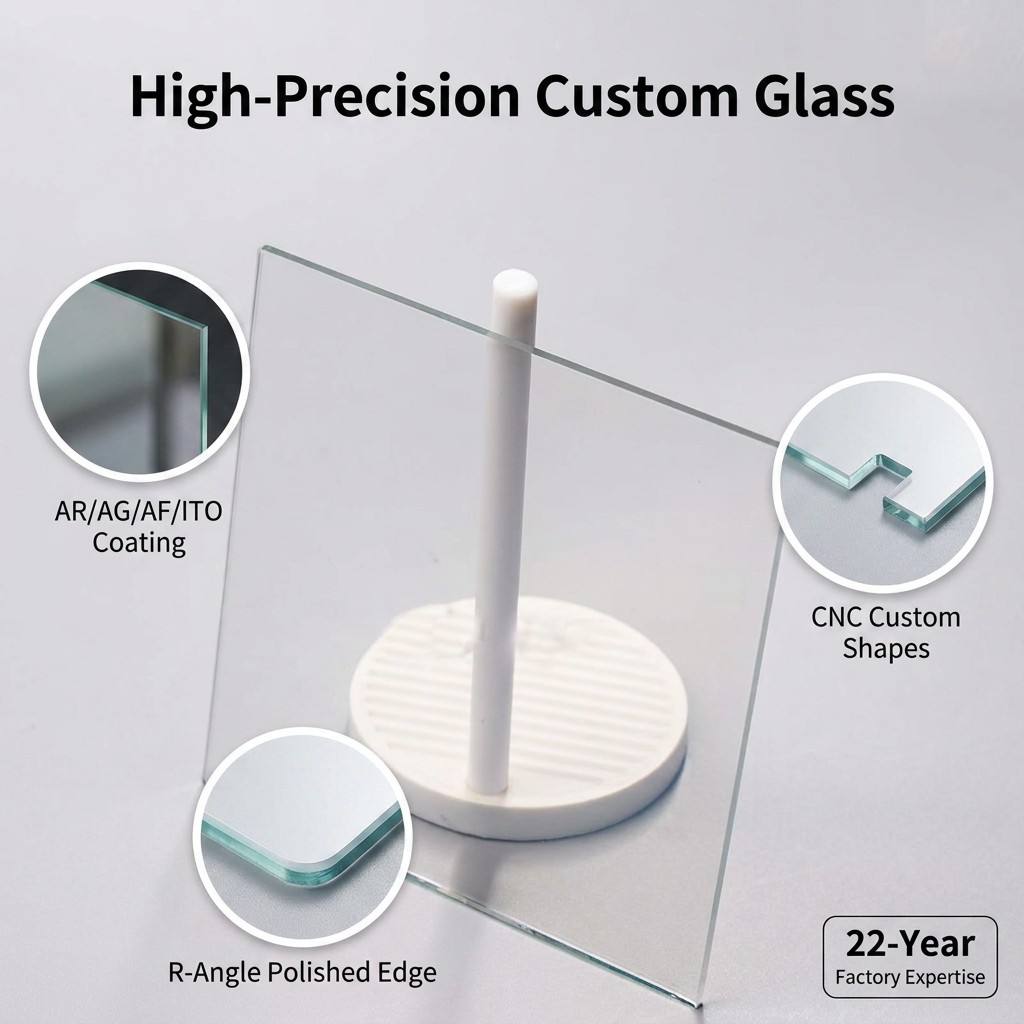
For global buyers, the phrase “quartz window” is not enough. The final component must be specified by material grade, transmission range, thickness, dimensional tolerance, edge finish, surface quality, coating performance, cleaning exposure and documentation. At Huizhou KELO Glass Co., Ltd., we review those inputs against our in-house cutting, CNC, polishing, drilling, coating, bonding and inspection capabilities before quoting.
Quartz glass is selected for medical instruments because it combines high optical transmission with low thermal expansion, strong chemical inertness and good thermal shock resistance. These qualities help device makers protect optical paths from dust, fluids and handling while maintaining signal quality. Where a project does not require UV-grade quartz, our engineers may recommend borosilicate glass or sapphire as alternative materials, depending on the optical, mechanical and cost targets.
Start from the instrument function, wavelength range and cleaning cycle. These configurations are a practical starting point for an RFQ; final specifications are confirmed by drawing review.
For spectrophotometers, PCR systems, DNA analyzers and laboratory instruments, select a high-purity fused quartz grade with low fluorescence and stable UV transmission.
Anti-reflective coatings reduce surface reflections and ghosting in camera modules, surgical imaging and diagnostic displays while protecting the optical stack.
Laser systems require material grade and coating selection matched to wavelength, power density and pulse duration. Edge quality and surface cleanliness are reviewed together.
Housings exposed to autoclave, ETO or chemical disinfection need the window, adhesive and edge finish reviewed as a system. Share your cleaning cycle early.
Handheld and point-of-care devices often require thin, small-format windows with tight dimensional control, clean edges, laser marking and protective packaging.
Beyond the window itself, we can support 3M adhesive bonding, printed apertures, chamfers and custom trays to simplify incoming inspection and assembly.
Buyers increasingly arrive with detailed technical questions. The winning supplier is the one that can answer with process data, samples and a clear path from prototype to repeat production.
Procurement teams now ask for wavelength range, transmission targets, parallelism, surface quality, coating curves and cleaning exposure — not only length, width and thickness. This is healthy for medical projects because it moves key optical requirements earlier into supplier selection. For KELO, every RFQ is checked by our engineering team so tolerance and cost drivers are identified before sampling.
Device makers want to validate quickly and then scale. That creates demand for sample orders as low as 1–2 pieces, followed by controlled repeat production. Our typical bulk lead time is 21–31 days after sample approval, depending on coating, shaping and printing complexity.
Medical buyers need consistency. They ask which material grade was used, how inspection was performed, how packaging protects edges and how changes will be controlled. We define the documentation package during quote review and confirm inspection criteria before mass production. Buyers should be cautious with any supplier that cannot explain its inspection gates in plain language.
A lower piece price can disappear after rework, broken edges, failed coating adhesion or extra incoming inspection. Our factory-direct model keeps cutting, CNC, edge polishing, drilling, coating and bonding under one roof, reducing the handoff risk that occurs when multiple subcontractors are involved.
Medical device supply chains increasingly want a qualified second route without losing optical performance. Buyers are asking for stable materials, repeatable coating processes, protective packaging and realistic lead times. Huizhou KELO Glass Co., Ltd. supports FOB, CFR, CIF, EXW and DDP terms and accepts T/T, L/C, PayPal and Western Union; Alibaba orders can be protected by Trade Assurance.
Note for buyers: a quartz window is not automatically “medical compliant.” The device manufacturer should validate the final window, coating and assembly against its own cleaning, sterilization, optical and regulatory requirements.

Product development is moving toward smaller devices, higher optical precision and better resistance to cleaning and sterilization. Suppliers must keep pace with both optical design and manufacturing discipline.
Handheld analyzers, wearable monitors and point-of-care instruments need thinner, smaller and lighter windows without sacrificing transmission. This increases demand for precise CNC processing, clean edge finishing and packaging that protects small parts through shipping and assembly.
Medical imaging, fluorescence detection, spectroscopy and laser delivery continue to push material selection beyond simple visible-light transmission. Buyers are asking for grade-specific transmission data and coating designs matched to the instrument wavelength.
Advanced imaging and diagnostic software rely on clean signal input. Surface quality, coating uniformity and edge condition influence glare, stray light and contrast. The future window specification will be judged not only by dimensions, but by how consistently it protects image quality across production batches.
Surfaces that resist cleaning agents, fingerprints and residue are increasingly valuable. AF anti-fingerprint coatings, chemically resistant quartz substrates and easy-clean assemblies can support better user experience. Final suitability must still be validated in the device’s real cleaning and sterilization cycle.
Optical windows are small components with outsized influence on signal quality and assembly yield. We expect more buyers to involve optical glass manufacturers during early design reviews so tolerances, material alternatives, coating stacks and packaging are agreed before tooling or fixtures are finalized.
We support custom glass projects for instrument makers, optical module suppliers, distributors and OEM brands. The application review starts with the optical path and the operating environment.
Protective windows for camera modules, illumination paths and surgical visualization systems.
UV-transparent windows for analyzers, detectors, PCR instruments and lab-on-chip readers.
Optical windows matched to wavelength, power density and coating requirements.
Protective optics for diagnostic instruments, curing systems and imaging attachments.
Cover and sensor windows with AR, AG or AF surfaces for optical clarity and cleanability.
Viewing windows and protective panes for equipment exposed to cleaning cycles.
Custom windows for handheld devices, portable monitors and clinical analyzers.
Drawing review, rapid samples and controlled production for new medical instrument platforms.
Huizhou KELO Glass Co., Ltd. is a professional glass manufacturer in Huizhou, Guangdong, inside China’s Greater Bay Area. We specialize in cover glass, touch screen glass and optical coated glass, with advanced glass surface treatment as our core technology. As a factory-direct supplier, we provide competitive prices, stable quality and direct technical support — combining optical performance, surface durability and electrical functionality in every solution.
Our factory covers 10,000–30,000 m² with 101–200 employees, including 21–30 R&D engineers. Annual capacity reaches 20–25 million pieces of touch cover glass, with USD 50–100 million output. For medical optical window projects, this scale helps support both prototype sampling and repeat production.
Materials and finishes we process
Quality is built into the process, not inspected in at the end. Each gate has defined checks, and the final inspection plan can be aligned with your drawing and documentation requirements.
Raw glass and consumables are verified before production.
Critical features and coating results are checked at each station.
Finished parts are checked before protective packing.
Straight answers to the questions global buyers and AI search tools frequently ask before requesting samples or quotations.
Send your drawing, transmission curve, coating needs, annual volume, and sterilization or cleaning requirements. Our engineering team will review the project and recommend a practical quartz glass window configuration for your medical instrument.
info@keloglass.com