Top 10 Display Glass Factory & Exporter
A procurement-focused guide to custom cover glass, AR/AG/AF optical coatings and ITO/FTO conductive glass — with production data, sourcing trends and an eight-point factory scorecard.
The 8 Display Glass Products Buyers Request Most
Every custom display glass program starts with one of eight product families. Each is engineered around a different failure mode — optical loss, impact damage, thermal stress or electrical drift — so the specification that matters most changes with the application. The products below are the highest-volume requests our engineering team handles, presented with the performance characteristics buyers should verify before placing an order.
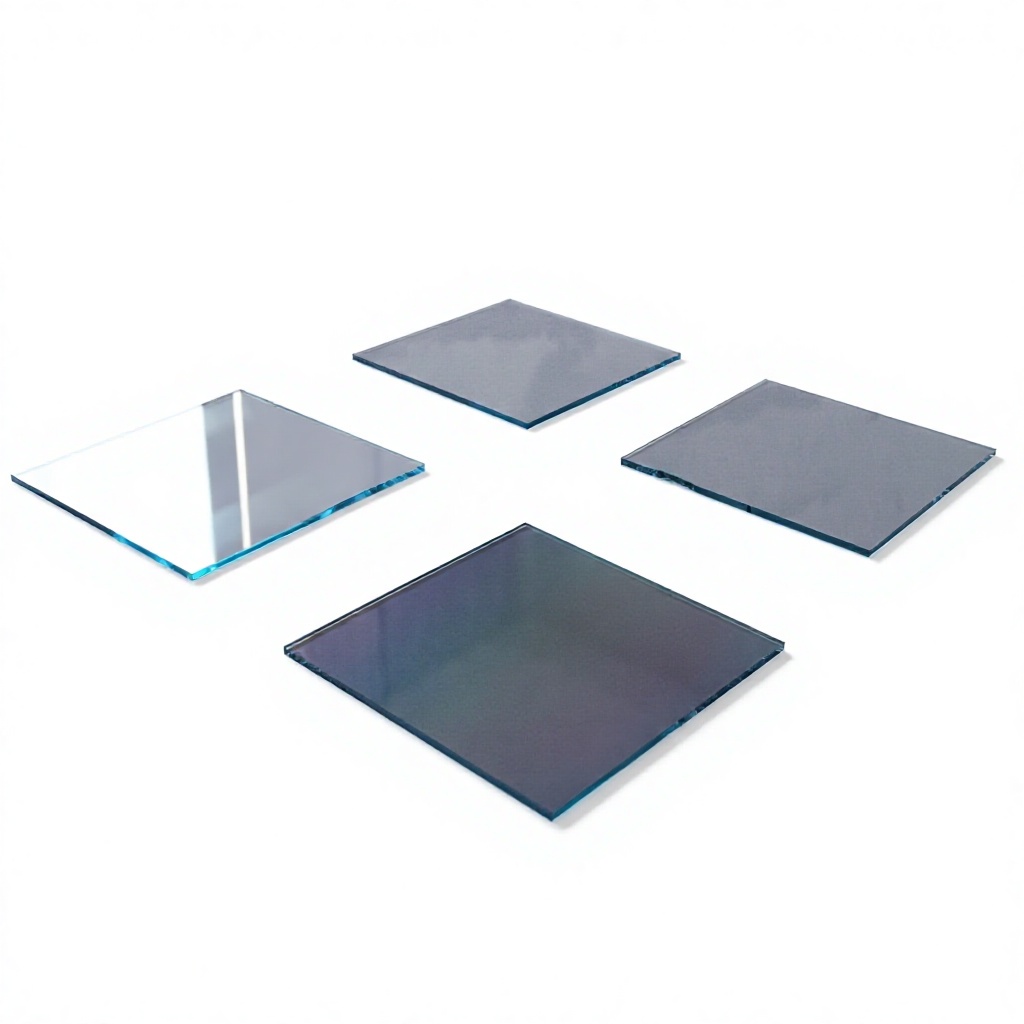
1.1mm ITO Coated Conductive Glass Panel
A 1.1 mm indium tin oxide coated substrate with polished edges, machined to custom shapes for industrial touch sensors, EMI shielding and transparent heating. Low sheet resistance paired with high visible transmission keeps the panel optically clean.
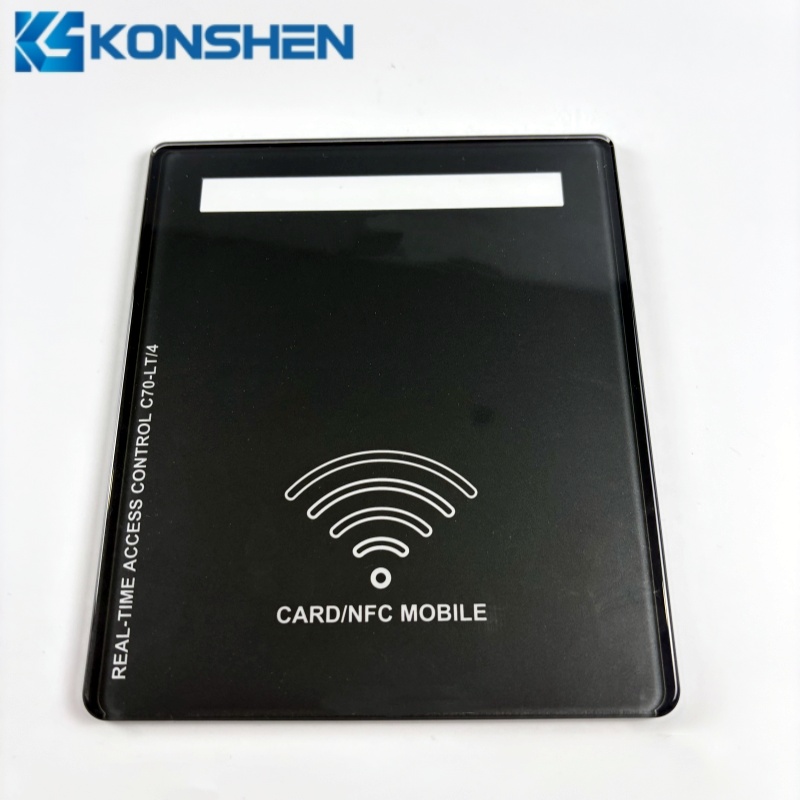
Custom 5mm NFC Tempered Glass Switch Panel
Tempered display cover glass with NFC capability and silk-screen printing — a scratch-resistant, glass-front control surface for access cards, smart locks and switch panels that must survive daily contact.
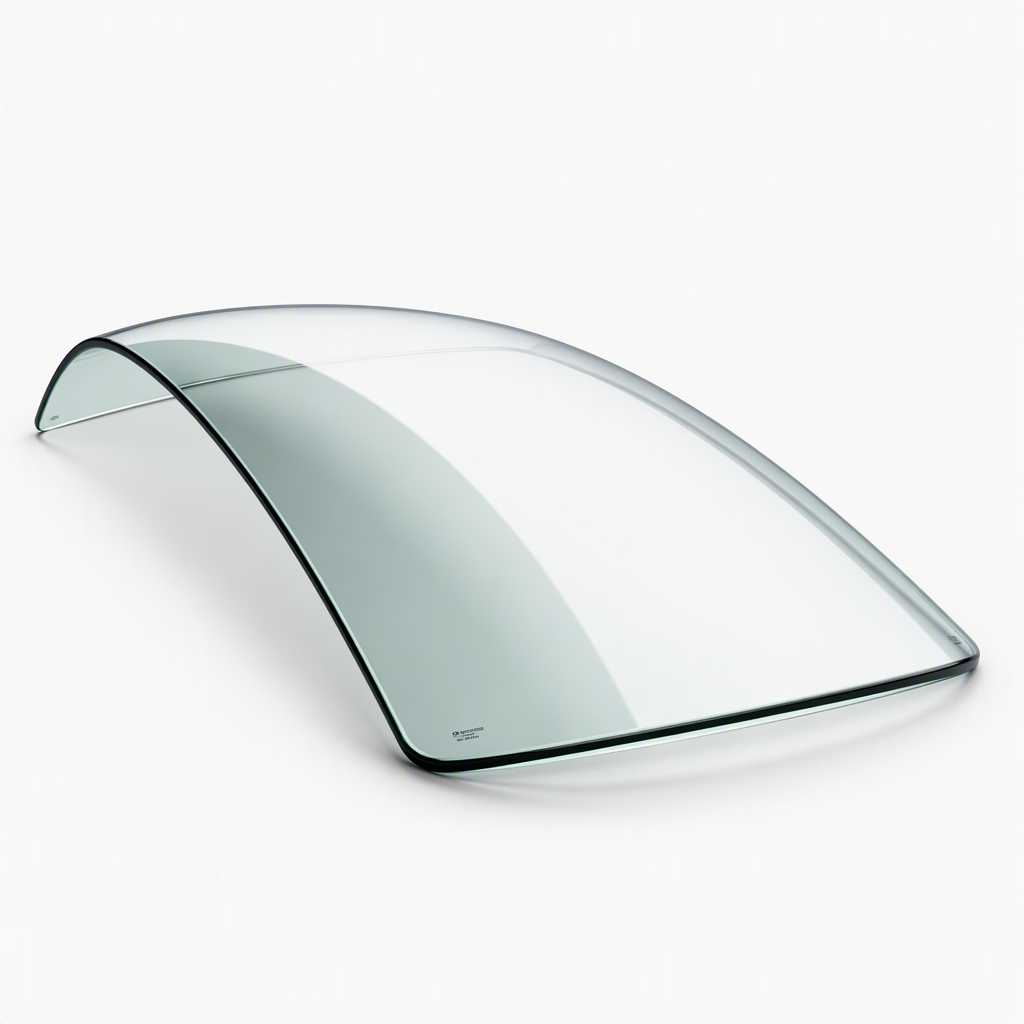
Hot-Bent Curved Tempered Glass for Automotive Displays
Small-radius hot-bent glass for automotive displays. 3D curved forming removes optical distortion at the bend and gives OEM/ODM programs a seamless, reflection-controlled interior surface.
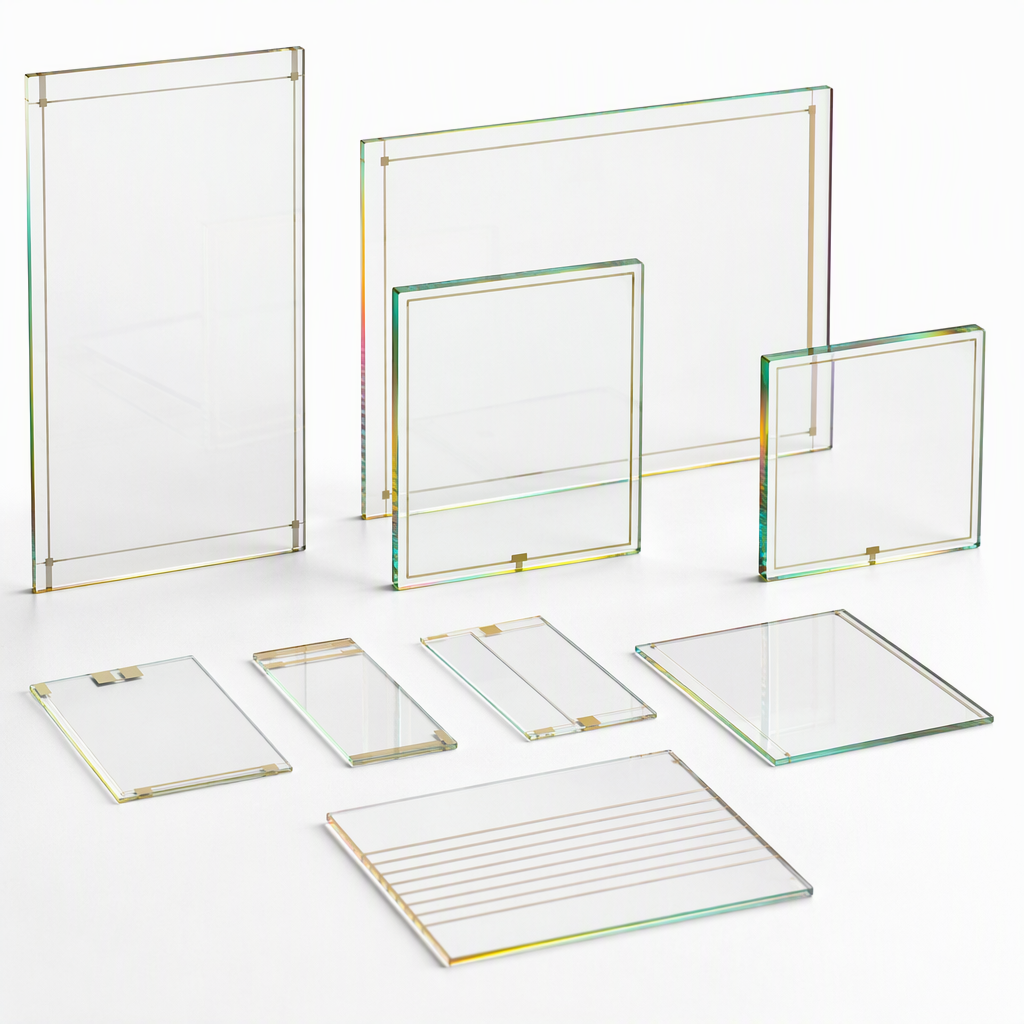
ITO Conductive Glass Sheet 6–8 Ω/sq
A 6–8 ohm per square ITO glass sheet used as a touch-panel heating substrate. Uniform resistance, stable output across temperature cycles and custom sizes for retrofit or new designs.

98% Transmission Anti-Reflective (AR) Glass
Anti-reflective glass with 98% transmittance for museum showcases, luxury picture frames and precision display windows. Reflectance below 1% preserves colour fidelity and eliminates ghost images.
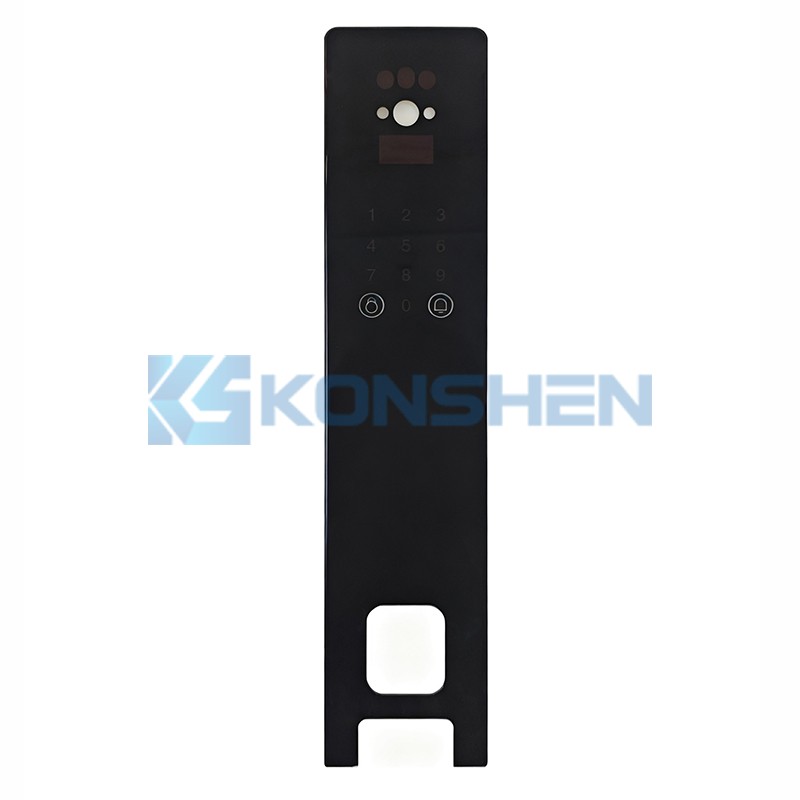
Electronic Tempered Glass Keypad Panel
Custom-printed tempered glass film for digital keypads and smart door locks. Wear-resistant graphics, precise icon registration and high impact strength in a thin, flat panel.
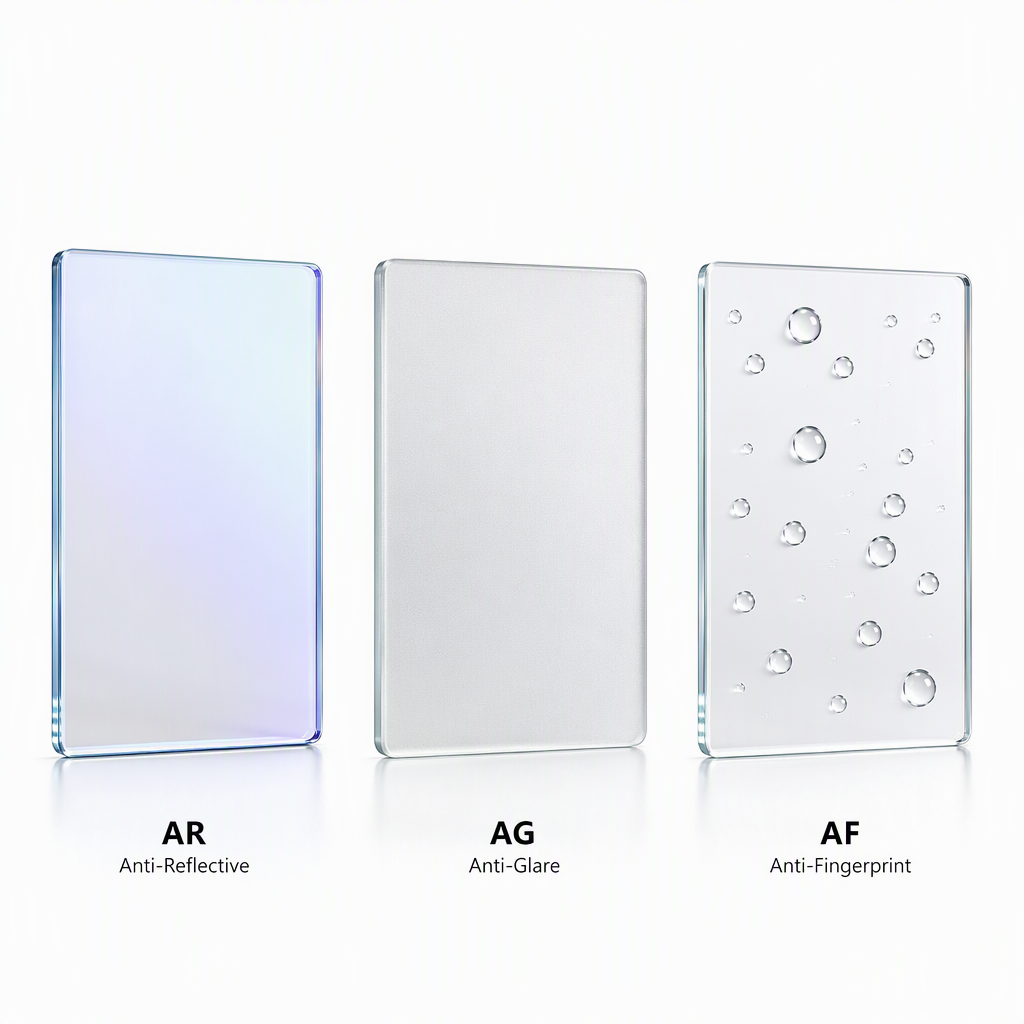
AR / AG / AF Composite Coated Glass
A multi-function optical stack — anti-reflective, anti-glare and anti-fingerprint — coated on a single sheet. 92%+ transmission with controlled haze keeps outdoor screens readable and clean.

Smart Touch Elevator Panel Glass
Cut-to-shape elevator indicator glass with arrow printing and integrated touch control. Stable electrical performance, low reflection and long service life in high-traffic buildings.
Why Display Glass Sourcing Deserves a White Paper
Display glass has quietly become one of the highest-leverage components in modern hardware. It is the surface users touch thousands of times a day, the optical window that decides how readable a screen is in direct sunlight, and — in conductive, coated and printed variants — an active functional layer rather than a passive pane. Yet many sourcing teams still compare display glass factories on price per square metre alone. That is an expensive habit. A 3% lower unit price is trivial next to a 30-day production delay, a coating that fails salt-spray testing in the field, or a batch of cover glass that cracks at the edge because the tempering profile was never engineered for the assembly method.
This white paper is written for procurement managers, hardware engineers and brand owners who need a repeatable way to compare display glass factories and exporters. It profiles the eight product families that generate most custom RFQs, maps the procurement trends reshaping supply decisions through 2030, explains the technology shifts happening inside the glass itself, and closes with an eight-point evaluation framework plus the buyer questions we answer most often. Every performance figure here reflects production capability — what a line can hold shift after shift — not a laboratory demonstration.
Company context: this guide is published by Huizhou KELO Glass Co., Ltd., a factory-direct display glass manufacturer based in Huizhou, Guangdong, and draws on specifications and trade data from live OEM/ODM programs.
Six Shifts Reshaping Display Glass Supply
Procurement behaviour has changed more in the last three years than in the previous decade. Buyers are consolidating suppliers, demanding evidence before samples, and modelling cost across the product lifecycle instead of the purchase order. These six shifts define how display glass supply will be judged through 2030.
From Unit Price to Total Cost of Ownership
Landed cost now includes rework, field failure and freight damage. Teams that model a five-year total cost of ownership consistently favour factories with in-house tempering and 100% appearance inspection over quotes that are 5–8% cheaper but depend on outsourced processing.
Functional Sampling Before Volume
Photo renders and catalogue sheets no longer qualify a supplier. Brands request functional samples — often just 1–2 pieces — to test coating adhesion, optical performance and fit inside an assembly. Factories without a rapid prototyping line are being removed from shortlists.
Vertical Integration as a Qualification Gate
When cutting, CNC, printing, tempering and coating happen under one roof, tolerances survive the handoffs between steps. Supplier scorecards increasingly award more points for process ownership than for catalogue breadth.
Compliance and Traceability Readiness
REACH, RoHS, material declarations and batch-level traceability are now standard attachments to a purchase order. Exporters with verified trade profiles and complete inspection records clear customs and third-party audits with fewer delays.
China + 1 Without Losing Engineering Depth
Final assembly is moving closer to end markets, but precision coating, curved forming and tight-tolerance glass processing remain concentrated in China’s Greater Bay Area. Buyers are structuring dual flows: high-mix engineering builds in China, volume assembly elsewhere.
Cycle Time as a Competitive Weapon
A 21–31 day mass-production lead time and a sub-one-hour quotation response are becoming baseline expectations. Programs are increasingly awarded to the supplier that can iterate fastest, not the one with the lowest first quote.
What Is Changing Inside the Glass
The glass itself is changing as fast as the supply chain around it. Thinner substrates, stacked optical coatings and application-specific conductive layers are turning display glass from a protective pane into a designed component. These six directions are shaping the next generation of RFQs.
Thinner, Stronger Substrates
Cover glass now spans 0.1 mm to 19 mm. Chemically strengthened thin glass delivers impact resistance comparable to much thicker float glass, enabling slimmer industrial HMI panels, lighter automotive stacks and edge-to-edge industrial designs.
Composite Optical Stacks: AR + AG + AF
Single-function coatings are being replaced by stacked systems evaluated as one optical unit. A combined AR/AG/AF stack can push transmission above 92% while holding controlled haze and a water contact angle beyond 110°.
Application-Specific Transparent Conductors
ITO remains the default for capacitive touch sensing at 1–20 Ω/sq, while FTO wins where thermal and chemical stability matter — thin-film solar, annealing steps and high-temperature sensors. Conductor selection is now driven by process temperature, not habit.
2.5D and 3D Hot-Bent Glass
Automotive interiors are driving demand for small-radius hot-bent glass with optical-grade clarity. Curved forming removes the seams and reflection bands of flat-panel assemblies, and OEM programs increasingly specify it at the drawing stage.
Glass as an Active Smart Surface
NFC access cards, touch keypads, transparent heating substrates and elevator control panels turn the cover glass into the interface itself. Silk-screen printing, embedded antennas and conductive layers now converge in a single substrate.
Sustainable Production and Packaging
Lead-free inks, water recycling and recyclable honeycomb cartons are moving from marketing claims to procurement requirements. Breakage-rate reduction is measured alongside optical yield, because fewer broken panels mean lower embodied carbon per shipped part.
How to Evaluate a Display Glass Factory in 8 Points
Most supplier shortlists are built on catalogues. They should be built on evidence. This eight-point framework mirrors the checklist OEM customers use during factory audits — and the criteria behind any credible top display glass factory ranking. Apply it before you release a purchase order.
Process Ownership
Confirm which steps run in-house. Ask for a factory walk-through video and match every process in your drawing to a machine on the floor.
Coating Capability
Request measured reflectance, transmittance, haze and adhesion data, not nominal claims. A factory that owns its coating line can adjust a stack without requalifying an outside vendor.
Metrology & Quality Gates
A credible factory documents IQC, IPQC and FQC criteria, performs 100% appearance inspection and reports tempering, abrasion, adhesion and salt-spray results per batch.
Engineering Support & DFM
The best suppliers flag tolerance stack-ups, tooling limits and coating constraints before quoting. DFM feedback at RFQ stage prevents expensive revisions later.
Sampling Speed
Ask how many pieces the prototype run requires and how long it takes. Suppliers that accept 1–2 piece sample orders are structurally faster to iterate with.
Verified Trade Record
Third-party verified assessments, transaction history, credit profiles and buyer ratings separate real exporters from trading intermediaries.
Export & Logistics Experience
Confirm Incoterms coverage — FOB, CIF, DDP — packing standards for fragile glass, and experience with your destination market’s documentation.
Communication SLA
Measure response time during the inquiry stage. A supplier that answers technical questions within an hour before the order will behave the same way after it.
Why KELO Glass Ranks Among the Top Display Glass Factories
Huizhou KELO Glass Co., Ltd. runs a factory-direct display glass operation in Huizhou, Guangdong, inside the Greater Bay Area electronics supply chain. Every critical step — water-jet cutting, CNC machining, edge polishing, laser engraving, silk-screen printing, flat and curved tempering, AR/AG/AF/ITO coating, 2.5D/3D curved forming and 3M adhesive bonding — happens under one roof. That vertical integration is why the specification approved on a sample survives into mass production, and why lead times stay predictable when volumes scale.
The operation is sized for both prototyping and volume: a 10,000–30,000 m² factory floor, 101–200 employees including 21–30 R&D engineers, 20–25 million pieces of annual touch cover glass capacity and US$50–100 million in annual output value. Sample orders start from 1–2 pieces, mass production typically runs 21–31 days after sample approval, and quotation requests receive a response within one hour.
Buyers can verify the record before committing: six years as a verified exporter on Alibaba.com, a 4.9/5 store rating, a 98.18% reply rate, a published credit profile and Trade Assurance protection on Alibaba.com orders. Trade terms cover FOB, CFR, CIF, EXW and DDP, with payment via T/T, L/C, PayPal or Western Union.
Current export distribution — evidence of documentation and packing experience in the markets that audit suppliers hardest:
Display Glass Procurement FAQ
The questions buyers ask before their first order — answered with the same numbers we quote in RFQs.
What is the minimum order quantity for custom display glass?
What is the typical production lead time?
What optical performance can your AR coating achieve?
Should I choose ITO or FTO conductive glass?
What thickness, sizes and shapes can you produce?
Which trade terms and payment methods do you accept?
How do you control quality?
Can you support OEM/ODM with NFC, printing or heating functions?
Have a Drawing or a Spec? Let’s Engineer It.
Send your drawing, target coating performance and annual volume. Our engineering team will confirm feasibility, recommend the most cost-effective glass stack and return a quotation — typically within one hour.
Get a Quote Or email info@keloglass.com — sample orders from 1–2 pieces.